

Cart
0
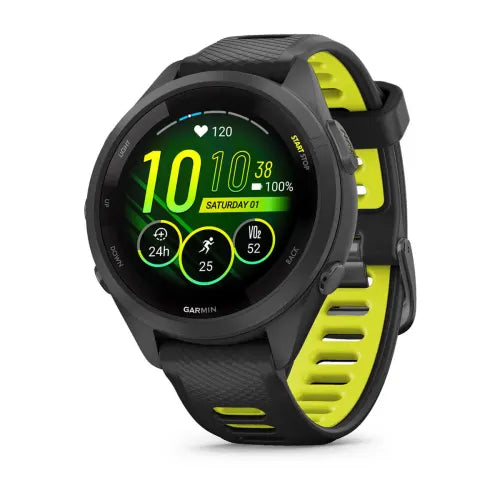
A useful running watch records the information you need, lasts through your session and stays comfortable. For a first 5K that may mean time, distance, pace and straightforward controls. For a marathon or longer event, the relevant GPS battery mode, route workflow and familiarity with the watch become more important.
The right Garmin is not defined by how ambitious your race sounds. Start with your current routine and the functions you will actually use. This is a watch-buying guide, not a training prescription or a promise that a device will improve your race time.
For your first consistent runs
Begin with a watch that lets you start, pause and finish an activity without confusion. Check that the information you want appears clearly while moving. A simple screen showing elapsed time, distance and pace can be more useful than a crowded display of metrics you do not yet understand.
Look at comfort as an essential function. A loose watch can move around; an overly tight strap can become unpleasant as a session continues. If you expect to wear the watch between workouts, assess whether the size also suits your everyday routine.
Forerunner 70 and 170 are options to assess in the catalogue, but read the exact current specification rather than assuming their numbers establish every difference. Music versions should be compared separately if storing audio on the watch matters to you.
When regular training creates more specific needs
Once you know what your training routine involves, identify the features that reduce friction. These could include structured workouts, lap information, selected training metrics, sensor connections or different activity profiles. Ask what you want the watch to help you record or organise, then check the exact model supports it.
Training readiness, recovery estimates and similar tools should be understood in their own context. A score is information to interpret, not permission to disregard illness, pain or professional advice. Read how the manufacturer defines a feature and what data it needs before making it a buying requirement.
Size comparisons you can actually use
| Model | Listed physical size | Listed weight |
|---|---|---|
| Forerunner 265S | 41.7 × 41.7 × 12.9 mm | 39 g |
| Forerunner 265 | 46.1 × 46.1 × 12.9 mm | 47 g |
| Forerunner 570, 42 mm | 42.4 × 42.4 × 12.9 mm | 42 g |
| Forerunner 570, 47 mm | 47 × 47 × 12.9 mm | 50 g |
| Forerunner 970 | 47 × 47 × 12.9 mm | 56 g |
These manufacturer figures give a starting point, not a comfort ranking. The strap and your wrist shape affect the result. Compare the stated wrist range and check the complete product specification. A smaller watch may suit one runner; another may prefer a larger information display.
GPS accuracy, mapping and pace screens
GPS records position, but conditions and settings can affect the resulting track. Multi-band positioning is a capability to compare, not a guarantee that every recorded point will be perfect. Test the settings you plan to use on familiar routes and learn how the device reports pace.
Instantaneous pace can be distracting if you react to every fluctuation. Consider whether lap information or another permitted data screen better supports how you review a run. Familiarity with the display is a practical reason to use your watch regularly before race day.
Mapping is a separate question. Forerunner 970 lists onboard mapping, but you should not assume every Forerunner does. If your training includes unfamiliar routes, ask about maps, course loading, offline use and the exact supported navigation workflow.
For a half-marathon or marathon
Check the manufacturer's battery claim for the GPS mode you intend to use. Leave a reserve for time before and after the event, changes to your expected duration and additional functions. A headline of many smartwatch days does not answer the event-recording question.
Think through your usual setup. Will you use music, connected sensors, a bright always-on display or a particular satellite mode? Check their implications rather than assuming the default maximum applies. Compare like-for-like activity modes between candidate watches.
Practise the recording routine on ordinary sessions: acquire a GPS position as instructed, start the activity, check data screens, mark laps if needed and save the session. Avoid making an untested setting change simply because it looks attractive immediately before an important run.
Music and sensors: useful only with the right compatibility
Decide whether you want to leave your phone behind or just control music playing on it. Those are different uses. Offline audio can require a compatible watch edition, service, subscription and headphones. Check your intended setup rather than treating the word 'music' as a complete specification.
If you want a chest strap or another sensor, verify the watch, sensor and desired metric together. Pairing support does not mean every advanced metric is available on every combination. An accessory should solve a defined need, not become an automatic addition to a new watch.
When to consider Venu or fēnix instead
If your watch is mainly for a varied everyday routine with occasional runs, compare the relevant Venu or vívoactive model as well. If your sessions also involve outdoor routes and specific navigation requirements, compare a suitable fēnix. Keep the decision model-based rather than assuming one family is compulsory for all runners.
The Forerunner vs Venu vs fēnix guide explains the overlap. For long outdoor activities, the hiking watch guide adds map and preparation checks.
Your running-watch purchase checklist
- Write down your longest usual recording session and preferred battery mode.
- Choose the training functions you understand and expect to use.
- Check wrist range, dimensions and complete watch weight.
- Separate GPS recording from mapping, and music control from audio storage.
- Verify any sensor, phone or subscription requirement.
- Keep the exact model and part number on your price comparison.
Frequently asked questions
Do I need a premium Garmin for my first marathon?
Not necessarily. Choose by your required recording functions, fit and activity endurance. A higher price alone does not establish a better match.
Can smartwatch battery days tell me how long a GPS run can be recorded?
No. Check the relevant GPS activity mode separately.
Which Forerunner size should I choose?
Compare the actual dimensions, stated wrist range and display needs. The smaller or larger version is not automatically better for every runner.
Ask Red Rhino about an exact running-watch shortlist with your wrist measurement and intended functions. Confirm current price and availability before purchase.
Continue your watch research
Sources and editorial scope
Prepared by Red Rhino from manufacturer documentation and our exact-model catalogue, checked 3 October 2026. These are buying guides, not hands-on test results. Confirm current price, stock and specification before ordering; regional features and services can change.


