

Cart
0
In a small kitchen, the most useful appliance is the one that solves a repeated task without taking away the space needed to prepare and serve food. A compact product can still be awkward if its door, lid, basket or bottle needs more operating room than expected. Plan the whole routine before choosing by the smallest advertised dimensions.
This guide is for Kenyan households setting up a compact kitchen or reducing counter clutter. It connects kitchen appliances with working space, storage, purchase priorities and useful multi-function choices.
Measure three kinds of space
Closed footprint
Record the appliance's width, depth and height where published. Compare them with the supporting surface and the manufacturer's placement requirements. Do not infer exact dimensions from a product photograph.
Operating space
Allow for opening lids and doors, pulling out baskets, lifting jugs, replacing bottles and handling hot food. A microwave door can conflict with a wall, while an air-fryer drawer can occupy the clear preparation area when opened.
Cleaning and storage space
Removable parts need room to wash and dry. Attachments need suitable storage when not in use. A combined appliance may occupy one base position but still come with several bowls and tools that need organisation.
Write these needs down before comparing products. The complete kitchen guide provides a wider workflow map for preparation, cooking, serving and cleaning.
Prioritise by frequency, not excitement
Give permanent counter space to appliances used frequently enough to justify it. Occasional baking or specialised preparation equipment may be stored safely between uses, provided the location and handling follow the instructions.
Make a list with three columns: task, how often it happens and equipment already available. Mark which task has a real problem. A microwave may solve daily lunch reheating; a blender may solve a repeated drink routine; a kettle may solve hot-water preparation. Each can be a better first purchase for a different household.
Avoid buying a product simply because another household calls it essential. Your own meals and drinks decide whether the appliance saves time and effort. A clear unused work surface can be more valuable than a machine for an infrequent task.
A staged buying plan for limited budgets
| Stage | What to decide | Practical result |
|---|---|---|
| First | The daily task causing the most inconvenience | One appliance with a clear purpose |
| Next | Whether another repeated task is genuinely different | A complementary purchase rather than duplication |
| Later | Whether specialised equipment earns its storage | A purchase based on observed use |
| Review | Which current items are used and easy to maintain | A less crowded, more functional setup |
Use live product prices to compare the total cost in KSh. Include necessary utensils, containers and organisation rather than spending the whole budget on the appliance body. A bundle is useful only when its components fit the tasks.
Compact kettles and breakfast choices
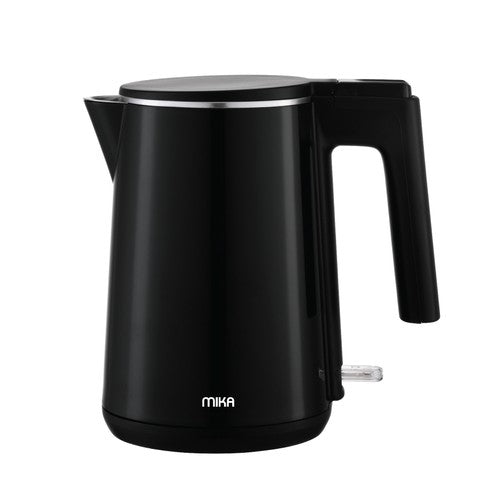
A smaller kettle can reduce its serving volume, but capacity and external dimensions are separate. Compare both. The Mika MKT3103B 1L kettle is a model to investigate for a smaller hot-water routine, not a universal answer for every compact household.
If several people make drinks together, a larger format may reduce repeated boils. Fill within its instructions and heat only the needed quantity. The best choice balances useful volume, handling and available space.
The breakfast-station guide helps decide whether a coffee maker, toaster or sandwich maker adds a distinct frequent task. The existing kettle-versus-coffee-maker guide can help avoid buying both before the need is clear.
Microwave or air fryer in a small kitchen?
A microwave and air fryer serve different cooking needs. If daily reheating is the priority, a suitable microwave may be the useful choice. If a circulated-hot-air cooking routine is the priority, an air fryer may fit better. Available space should shape the model, but the task should choose the family.
For a microwave, check the regular plate or container, door opening and required ventilation. For an air fryer, check usable basket area, drawer movement and the place where you handle hot food. A litre rating alone is not an external footprint measurement.
Read the microwave guide and existing air-fryer capacity guide before choosing. If both tasks are frequent, plan how both appliances can be used without blocking preparation space.
Combined preparation appliances: real savings and hidden storage
A blender with listed accessories or a food processor can cover several permitted preparation tasks. That may reduce the number of separate bases, but the accessories still need storage and cleaning. Review the attachment list and imagine the full routine.
If tasks happen one after another, changing tools may be convenient. If two people prepare different foods simultaneously, one combined base can become a bottleneck. Neither arrangement is automatically the most space-efficient in actual use.
The preparation-appliance comparison explains the task differences. The Mika MCH151GR multi chopper is an example of a specified attachment set, not proof that one machine replaces every preparation family.
Water dispensing without guessing the fit
A tabletop dispenser uses worktop space and needs a suitable supporting surface. A floor-standing model uses floor space and requires loading access. Either may be suitable, but compare the full installation, including the water bottle and clearances.
A bottom-load design can change the bottle-replacement routine without automatically reducing the total floor footprint. A portable normal-water dispenser serves a different task from a heated or cooled dispenser. Start with the temperatures you need.
The water-dispenser guide separates loading, cooling and cabinet functions. Avoid allocating space to extra heating or cooling equipment when it does not serve your household.
Storage that supports daily use
Keep appliance-specific blades, lids and couplings together with the model code. Safe storage should protect sharp parts and prevent incompatible accessories being mixed. Do not pile heavy items onto delicate lids or controls.
Use suitable organisers to reduce wasted space around utensils and containers. The existing Joseph Joseph organisation guide offers connected ideas, while kitchen organisation products can be evaluated against the exact space problem.
Leave a clear preparation area and a drying route. Storage should make an item easier to retrieve and return; it should not create a difficult lift each time you want to use an appliance.
Power, placement and maintenance
Check the electrical suitability and manufacturer's placement requirements for your planned setup. Several compact heating appliances can still have a substantial combined power requirement. A small physical size is not evidence of a low electrical load.
Use the energy-cost guide to estimate tasks and the care guide to organise cleaning and storage. Follow the manual rather than enclosing an appliance to make the counter look tidy.
Small-kitchen do's and don'ts
- Do measure closed, operating and cleaning space.
- Do prioritise appliances used frequently.
- Do identify existing equipment that already performs a task.
- Do include attachment storage in a combined-appliance comparison.
- Don't treat a small litre rating as proof of a small footprint.
- Don't obstruct ventilation or store items on active heating equipment.
- Don't compare convenience without accounting for washing and assembly.
- Don't buy a duplicate function solely for a coordinated appearance.
Small-kitchen FAQs
Which appliance should I buy first?
Choose the one that solves the most frequent unresolved task. Hot drinks, lunch reheating, ingredient processing and rice preparation lead to different priorities.
Is a multi-function appliance always the best space choice?
No. Compare the included tasks, accessory storage and whether jobs need to happen simultaneously. A smaller number of bases does not necessarily mean a smaller full storage requirement.
Can I put a countertop microwave in a cabinet?
Only where the manufacturer permits that installation and all requirements are met. A countertop design should not be assumed suitable for a built-in enclosure.
Should every appliance remain on the counter?
No. Frequent-use equipment may justify a permanent position; occasional-use equipment can be stored as instructed when safe and convenient to retrieve.
Can I mix brands in a compact setup?
Yes. Match each exact model to its task and dimensions. The cross-brand guide and Mika household guide help connect the options.
Build around the space you actually have
Browse kitchen appliances after completing the task and space list. Check current dimensions, instructions and availability on exact product pages. Prepared on 1 October 2026; product examples are planning references, not a promise that every kitchen or household requires the same set.


