

Cart
0
A complete kitchen is a kitchen where ingredients, cooking, serving and cleaning work together. It does not require every appliance on sale. For a Kenyan household, the best setup depends on the meals you actually prepare, the number of people sharing the space and the worktop, storage and power arrangements available.
Begin with the daily sequence: store food, prepare ingredients, cook, serve, deal with leftovers and clean. This guide connects kitchen appliances with cookware, knives, organisation and drink preparation. It focuses on portable and countertop equipment and household workflow rather than large-appliance installation.
Plan five kitchen zones
Preparation
Allow a clear surface for a chopping board, ingredients and a bowl. Keep a suitable knife within safe, organised storage. If you add a chopper or blender, plan where ingredients go before and after processing. A machine cannot compensate for having nowhere to place the finished food.
Cooking
Place cooking equipment where its supplied instructions permit, with the required clearances and suitable power or fuel arrangements. Consider how you will open a lid, pull out an air-fryer basket or remove a hot dish. Operating space is larger than the appliance's closed dimensions.
Drinks and breakfast
A kettle, cups and a tray create a simple drink station. A coffee maker, frother, toaster or sandwich maker can extend it when those tasks are part of your routine. Keep pouring and hot-surface areas away from crowded preparation work.
Storage and serving
Choose food containers, serving bowls and utensils that suit your actual portions. Distinguish food-storage suitability from microwave, freezer, oven and dishwasher suitability: each is a separate property. Check lids as well as container bodies before heating or washing.
Cleaning and waste
Allow room to empty scraps, wash utensils and dry removable parts. Dish racks, cleaning brushes and bins help complete the cycle. A kitchen that is easy to reset after dinner is more useful than a crowded counter full of appliances.
Build your setup around a normal week
Write a short menu covering breakfasts, work lunches and dinners. Include the busy day when time is limited, the batch-cooking day and a weekend meal. Then match appliances to repeated jobs. This avoids buying equipment because it appears in a lifestyle photograph.
| Routine | Useful equipment to consider | What to confirm |
|---|---|---|
| Tea and simple breakfasts | Kettle, suitable toaster or sandwich maker, cups | Quantity, bread fit, available sockets and cleanup |
| Meals cooked from scratch | Knives, board, cookware, optional chopper | Cut texture, batch size and compatible cooking surface |
| Packed lunches | Containers, suitable reheating appliance, serving utensils | Container compatibility and realistic portions |
| Repeated rice dishes | Rice cooker or suitable existing cooking equipment | Rice measure, cooked yield and warm-holding instructions |
| Pressure-cooking recipes | Electric pressure cooker and suitable utensils | Fill limits, recipe guidance and pressure-release method |
| Texture-focused small meals | Air fryer and permitted cookware or accessories | Basket footprint, spacing and total batches |
| Shared drinking-water point | Water dispenser and suitable cups or bottles | Temperature modes, loading and cleaning |
This is a planning table, not a requirement to buy all the equipment in every row. Several routines can share the same knife, bowl, cookware and storage system.
A starter kitchen: solve daily needs first
A first kitchen usually benefits from a modest number of dependable tools. Start with suitable cookware for your existing cooking arrangement, a knife and board, utensils, washing tools and food storage. Add the appliance that removes the most frequent inconvenience.
If hot drinks are made several times a day, a suitable kettle may be the first useful addition. If you mainly eat prepared meals, a microwave may matter more. If you prepare ingredients in larger batches, a chopper can be valuable. The decision should be based on repeated use, not a universal starter bundle.
Use the small-kitchen planning guide to prioritise within limited space. Build in stages so you can observe what the kitchen lacks. After two or three weeks of real use, your next purchase is likely to be more informed than a large initial order.
A family kitchen: plan simultaneous work
For a shared household, total batch time matters. A small basket used three times may be less convenient than expected. Two people preparing different foods need clear surfaces and storage that do not force them to repeatedly move hot equipment.
An air fryer can handle suitable foods while a separate cooker prepares a different dish. A chopper can prepare ingredients before cooking begins. A microwave can have a reheating role without replacing the main cooking setup. Compare the tasks that need to happen together before deciding that one multi-function appliance can do everything.
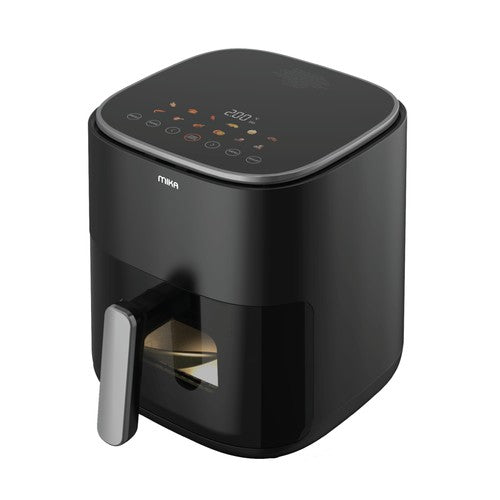
The Mika MAFDW2105 5L air fryer is a model example, not a guaranteed portion count. Read the air-fryer capacity guide to assess food shape and basket space. For beans, stews and other suitable pressure recipes, use the pressure-cooker versus rice-cooker comparison to assess full cycle time.
Match cookware to appliances
Cookware and appliances should be selected as a system. A pan that suits one cooking surface may not suit another. A container that stores leftovers may not be suitable for a grill. A baking accessory may reduce the usable space inside an air-fryer basket.
Read the material and use instructions for the cookware and the appliance. Check whether a handle, lid or coating has a separate temperature restriction. Do not interpret “heat resistant” as permission to use the item in every oven, microwave or air fryer.
Explore the cast-iron and non-stick comparison and Luigi Ferrero cookware guide when building the cooking side of your kitchen. A suitable spoon, turner and serving utensil can matter as much as an extra cooking machine.
Preparation appliances and manual tools work together
A sharp, suitable knife and stable board handle small jobs efficiently. A chopper becomes useful when the same preparation is repeated or quantities increase. A blender produces a different result from a chopped ingredient mixture, while a juicer separates juice and pulp according to its design.
For a stew, decide whether you want coarse pieces, a fine chopped base or a blended sauce. For a fruit drink, decide whether you want the whole blended mixture or extracted juice. These decisions tell you which appliance family to investigate.
The Mika MCH151GR multi chopper and a jug blender should be compared by their listed tasks rather than treated as interchangeable. Read the preparation-appliance guide, then connect it with the Victorinox kitchen knife guide for the manual preparation tools.
For repeated baking preparation, read the mixer buying guide before selecting tools and working quantities. For tabletop cooking, read the gas-versus-induction guide to check cookware compatibility and the required setup.
Create a breakfast station without duplicating functions
A kettle, filter coffee maker and milk frother do different jobs. The kettle heats water; the coffee maker brews coffee using its specified method; the frother processes milk according to its modes. Buying all three makes sense only if the household uses those drinks often enough.
A toaster browns bread in its slots. A sandwich maker cooks a filled sandwich between suitable plates. A contact grill can be a separate cooking tool. Check food dimensions and plate-cleaning arrangements rather than assuming one format replaces all the others.
The breakfast-station guide gives a useful buying sequence. It links the drink appliances with storage, cups and serving space so the area remains convenient after the first week.
Make hydration fit the kitchen and household
A water dispenser may belong outside the main kitchen if that gives the household easier access. Think about bottle deliveries, replacement space, drip handling and cleaning access. A tabletop model needs a suitable surface; a floor-standing model needs its own clear location.
Choose temperatures deliberately. Hot and normal water may cover one household's routine, while another prefers cooled water. Bottom loading can reduce the lifting height when replacing bottles, but cooling type remains a separate model feature.
Use the water-dispenser buying guide to compare formats. Avoid crowding a dispenser into a gap that prevents the ventilation or maintenance access required by its manual.
Build a mixed-brand kitchen intelligently
You can combine Mika appliances, Philips preparation equipment, Beko breakfast appliances and cookware or organisation products from other stocked brands. Brand coordination can look attractive, but practical compatibility comes from dimensions, functions, materials and instructions.
There is no requirement to choose one brand for every job. Compare exact models and keep a record of each model code so you can locate the correct manual and replacement part later. Our cross-brand appliance comparison explains the approach, and the Mika household guide maps the Mika range by routine.
For storage and sink organisation, the existing Joseph Joseph guide connects useful tools to the rest of the kitchen. Choose an organiser because it solves a specific space problem rather than because every item needs to match.
Budget in KSh without confusing cost and value
Separate the total budget into essentials, a first useful appliance and later additions. Keep room for containers, utensils and cleaning tools. A lower purchase price can be good value when the appliance suits the workload; a more expensive model can be worthwhile when an extra feature is used frequently.
Compare current basket totals on the product pages rather than treating an article's example as a live quotation. Consider the number of portions per session, cleaning time, replacement parts and ongoing energy use. The electricity-cost guide shows how running time changes energy comparisons.
A useful approach is to write “buy now”, “buy later” and “already covered” beside each task. If your current equipment performs a job satisfactorily, an upgrade should have a clear reason. That keeps kitchen planning grounded in everyday needs.
Test the kitchen plan before buying everything
Walk through a busy breakfast
Imagine filling the kettle, opening the bread appliance, finding cups and serving drinks. Check whether the preparation surface remains available and whether the hot pouring area conflicts with someone washing dishes. Confirm that each appliance can operate in its permitted location without moving another hot item.
This exercise can reveal that one additional tray or a better cup-storage arrangement helps more than another machine. If a coffee maker is planned, include the filter and carafe cleanup rather than stopping the walkthrough at the first cup.
Walk through an ordinary dinner
Place ingredients, board and bowl where they will be used. Imagine removing a processed mixture, opening the cooker and setting down a hot dish. Check whether the cooking tools and serving utensils can be reached without crossing the active preparation area.
For a meal with several components, note which tasks can happen in sequence and which must happen together. That distinction decides whether one combined preparation base is convenient or whether separate equipment earns its place. Include the storage of leftovers and the permitted container route.
Walk through the cleanup
Count the removable parts and where each can be washed and dried. Include baskets, jugs, lids and utensils, not only the main appliance bodies. Confirm each part's wash permissions. If drying parts occupy the entire preparation surface, improve the organisation before adding more equipment.
Then imagine returning everything to storage. Sharp tools should be protected, model-specific attachments kept together and the clear surface restored. The kitchen should feel ready for the next session. A setup that passes these three walkthroughs is based on real use rather than a product checklist.
Do's and don'ts for a practical complete kitchen
- Do measure operating space, including lids, doors and pulled-out baskets.
- Do check socket and circuit suitability for the equipment you plan to use together.
- Do store manuals, purchase records and model codes in one accessible place.
- Do keep a clear path from preparation to cooking to serving.
- Do plan where wet parts dry after cleaning.
- Don't assume larger capacity means more usable space for every food.
- Don't transfer containers or accessories between appliances without checking compatibility.
- Don't let colour matching override the features you actually need.
- Don't buy several appliances for the same infrequently used task without a clear reason.
Complete-kitchen FAQs
What appliances do I need for a complete kitchen in Kenya?
There is no fixed list. Start with the equipment needed for your meals, drinks, preparation and storage. A kettle, microwave, blender or cooker becomes essential only when it serves a frequent household task.
Is an air fryer enough for family cooking?
It can handle suitable dishes, but capacity and batch requirements vary. Plan the whole meal, including foods that need a different cooking method. A basket's litre rating is not a universal family-size guarantee.
Should I buy a kitchen bundle?
A bundle can be useful when every included item suits the household and the total price is attractive. Compare each component with your needs and check whether accessories are included or separate purchases.
Can I mix brands?
Yes. Select each item by task, dimensions and instructions. Parts and accessories should remain model-specific unless the manufacturer explicitly confirms compatibility.
How do I keep a complete kitchen from becoming cluttered?
Reserve permanent counter space for frequent-use appliances. Give occasional-use equipment and attachments labelled storage, and leave a clear preparation area. Review unused appliances before buying more.
Continue planning
Browse kitchen and dining products, food-preparation appliances and cooking appliances according to the tasks you identified. Follow the care and maintenance guide to keep the whole setup usable. This guide was prepared on 1 October 2026; verify current model details, prices and availability on the linked product pages.


